
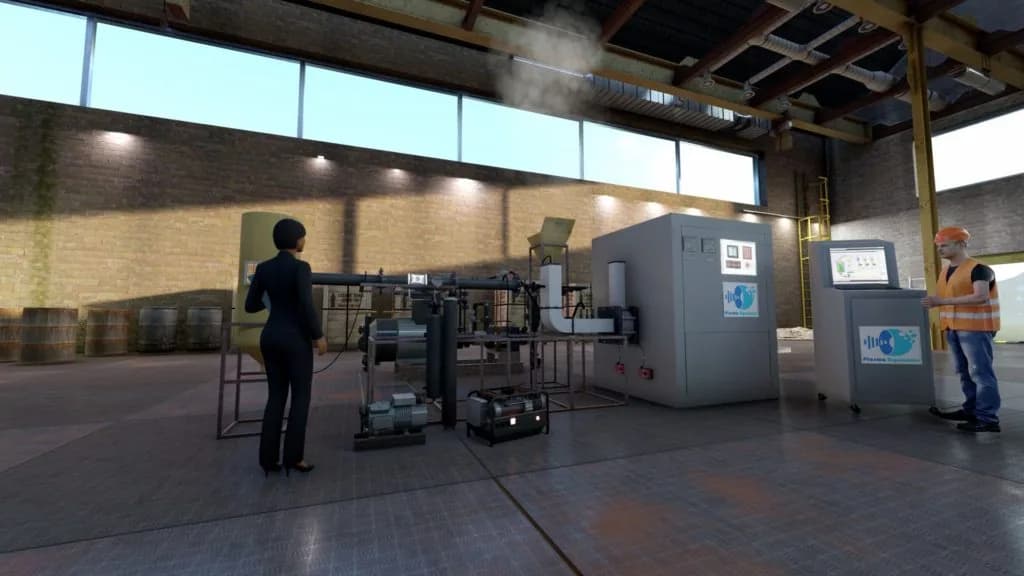
Biofuels from vegetable oils have great potency in energy demand since biofuels are renewable sources of energy. Biofuels from vegetable oils can be produced through the cracking process of the vegetable oils with plasma-assisted catalytic cracking. Some vegetable oils are used as raw materials for biofuels production including palm oil, cottonseed oil, canola seed oil, soybean oil, jatropha oil, sunflower seed oil, and others vegetable oils. Many methods have been suggested to convert vegetable oils to biofuels, i.e. transesterification or cracking process, while the most developed processes are the cracking processes.
The Cracking process of vegetable oils is pyrolysis – thermal cracking, catalytic cracking, and hydrocracking-deoxygenation. Advanced cracking process technology is Microwave Plasma -assisted catalytic cracking process. Plasma discharge has an important role to assist the electron excitation in the covalent bond of reactant molecules, i.e. breaking C-C, C=C, etc., so that the cracking process can be conducted easily.
Plasma Power is intended to Design and adaptive Manufacture the Process Plant with unique plasma-based technology using Plasma Cracking Process for Vegetable Oils Conversion to Biofuels.
Microwave plasma
Microwave plasma is a combination of microwave discharges generated by electromagnetic waves with frequencies exceeding 300 MHz. For obtaining the microwave discharges, plasma generators are used being called plasmatrons, which serve for supplying electromagnetic energy into the discharge volume. The generation of microwave plasma requires special devices, including a microwave oscillator, a magnetron, and waveguide equipment, which makes it possible to create an electromagnetic field with a strength exceeding 30 kV per cm in the discharge volume (resonator). In turn, it leads to the emergence of breakdown voltage and avalanche ionization of the plasma-forming gas (air, steam, inert gases, hydrogen, oxygen, etc.) as well as the formation of the plasma clot. An area of “plasma combustion” called a plasmoid is given the shape of a torch (plasma jet) with the help of an organized flow of plasma-forming gas, which is deduced outside the plasmatron. Thus, a double effect is achieved including protection of the plasmatron from overheating as well as destruction making a powerful tool for application in intensive high-temperature impact on organic and inorganic substances.