
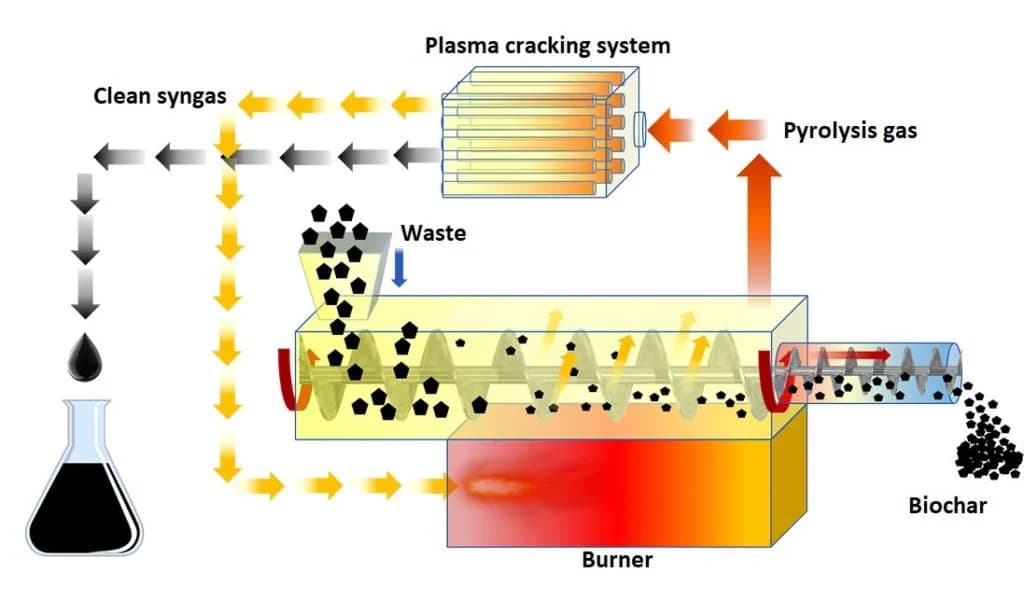
Pyrolysis gas generated during biomass gasification is currently regarded as a source of energy gas for replacing expensive natural gas, for chemical synthesis and as a fuel for thermal energy generation. Today, the main task of a modern pyrolysis gas cracking plant is to transform raw gas into environmentally friendly fuel in the most economical way possible.
The direct use of gas pyrolysis is complicated by the presence of aromatic substances in its composition. In this regard, the development of effective and cost-effective gas pyrolysis cracking processes is of particular importance.
pyrolysis gas cracking processes will make it possible to prepare raw gas for heating and hot water boiler feeds or for use as fuel for gas generation stations in accordance with modern environmental requirements.
Particularly promising at the moment is the method of plasma destruction (Cracking) of long molecules, tar in the pyrolysis gas.
The technical task involves developing the technology of a plasma pyrolysis gas cracking plant using a microwave plasma filter. An important task is the cracking of the pyrolysis gas and the conversion of resinous substances (resins, tars, aromatic molecules) into a gaseous state, thus increasing the energy value of the gas.
The dirty pyrolysis/gasification gas has less calorific value (Potere calorifico), and also the dirty gas is harmful for generator systems (for further electroenergy productions), because due to dirty gas, the generators often needs in repair or change! So with Microwave plasma system, we can purify the gas and thus increase the specific heat of combustion (Potere calorifico)
PLASMA FILTER - REACTOR FOR IONIZATION AND THERMAL DESTRUCTION OF SMOKE GASES
Special attention will be required to develop a “plasma filter”, a specific reactor in which the plasma-forming gas is actually synthesis gas, which, being ionized, forms a high temperature field (1500 °C – 4000 °C), which effectively decomposes all complex compounds (Resine, catrami, molecole aromatici etc.).
Our technology is based on the basic properties of microwave plasma, which make it possible to very effectively act on a number of carbon-containing substances, including gaseous ones, from the point of view of their destruction. The use of microwave plasma makes it possible to achieve average operating temperatures about 2500 °C. In this case, the heating rate for different substances in the reactor will be from 100 to 1000 °C / sec. In parallel to the action of high temperatures, the powerful ionizing effect of microwave plasma in the reactor volume leads to the complete decomposition of complex molecules of carbon-containing substances into the simplest molecules and ions, which allows, using the method of microwave plasma destruction of substances, to achieve a carbon conversion of 99-99.5%. This is the most important condition for the processing of exhaust flue gases, in which the carbon component can reach 40%, with a potential energy of their chemical synthesis of 105-107 J / cm3, and under certain conditions, the energy that can be obtained from such gases can exceed the energy production itself, due to the application of the method of microwave plasma cracking.
Therefore, the use of equipment “plasma filter” for cleaning flue gases by microwave plasma destruction seems to be very effective for various power generating, processing enterprises and industries.